Welcome

Hi people.. The purpose of this blog is to have a record of all the important articles at one place.. Happy Reading !!

Saturday, October 22, 2011

Tata Indicom : RIP (2006-2011)

Tata Indicom is dead. The CDMA brand from Tata Teleservices is going to be integrated ( migrated / replaced/exorcised) to Tata Docomo. According to various newsreports, the Indicom brand will be killed and the entire mobile telephony and related services will be brought under the Tata Docomo brand.
By bringing the entire services under a common brand, Tata Teleservices will be able to reduce the marketing costs and avoid brand confusion.
But a dead brand is a dead brand. For me every dead brand is a failed brand.


The new move also marks the larger role played by NTT Docomo in the mobile services JV with the Tata. The branding to Tata Docomo shows the prominence of DoCoMo brand which is the primary brand and Tata brand name is being used as an endorser brand.

Tata Indicom as a brand was not able to create any strong image in the consumer mindspace. The poor quality ads and confused positioning put the brand way behind aggressive competitors like Vodafone, Idea and Airtel. But compared to Tata Indicom , DoCoMo is an aggressive brand and the promotions are clutter-breaking. By bringing all services under a single brand especially in a low-margin, highly competitive market like cellular services make immense business sense.


CDMA services also did not quite clicked in the Indian market and consumers were not convinced about the technological supremacy of CDMA over GSM. Now that Tata Teleservices got a foothold over the GSM services through the Docomo JV, the relevance of Tata Indicom's CDMA services has diminished considerably. I wouldn't be surprised if the entire CDMA services will be put in the backburner by Tata Teleservices.


RIP Tata Indicom ..

Sunday, October 16, 2011

Modi Vs. Gandhi


Sl.PointsMr. ModiMr. Gandhi
1.Political Party SupportAfter the retirement of Veteran leader and Former Prime Minister of India, Mr. Atal Bihari Bajpayee, BJP has been struggling to even find a suitable leader for their Party. Although many leader within BJP do not support the way of execution of Mr. Modi, he seems to be the only man who can be fit for the Post, unless Mr. Advani gives it a desperate last Try at the age of 84.Being the Scion of the Gandhi family, being the son and the Grandson of former Prime Ministers of India and very importantly being the Son of Smt. Sonia Gandhi, who is presently the President of Indian National Congress, he will be someone who can claim the full support of his team once he is decided to be the candidate.
2.India Against Corruption SupportIn the Current Political Scenario of India, we cannot rule out point that whomever IAC supports, will get some extra Advantage. IAC has never said that they support BJP, but Anna himself have praised Mr. Modi for his marvelous work in Gujarat. So if he is the Prime Ministerial candidate, we might expect a bit of their Support, if not fully.IAC’s campaign is against corruption and presently Govt. is their prime target where they have proved many UPA leaders to be corrupt. So it is obvious that anyone can get IAC’s support, but not Mr. Gandhi
3.Work/Activities/AchievementsWhen the Name of Mr. Modi comes in, I bet, even Mr. Gandhi won’t be saying a word regarding the phenomenal work he has done for Gujarat. Agriculture, Manufacturing, IT, Tourism, Social development – infact he has worked for the development of the state in every field.
So if the point of Activities is concerned, Mr. Modi is the only choice in whole India.
At only 40, Mr. Gandhi has still not got the opportunity to execute any developmental work. So unless we give him the opportunity, we cannot speak about his abilities.
Although, he has shown quite a good job in mobilizing the Youth of the Country and this activity has claimed him to be the Youth Icon of India
4.ImageWe should always understand that a Prime Minister is not only known for his work, but for being the PM, the Image that someone possesses is also of utmost importance.
Mr. Modi has formulated his image to be a determined man with the Desire and more importantly ability to do betterment for the People. Speaking of the negative side, he is image is hugely tainted regarding the 2002 Gujarat Riots. But again, with Supreme court clearing him of all the charges, his image will be revived a lot.
At least till the last few months, Mr. Gandhi’s image was that of the Next-Gen India. His actions, body language, way of speaking in the Parliament, clearly revealed him as a strong personality. Very importantly being Gandhi scion, his image is 100% to the Hard core Congress followers.
But over his inability to handle the Situation regarding Jan Lokpal Bill and his extended speech during the Zero hour while Anna was on fast, have undoubtedly lowered his image to a lot.
5.Age and ExperienceBorn in 1950, Mr. Modi is around 60+, Mr. Modi does have his experience as a Plus pointAlthough Rahul is only 40+, he still does show promise. It’s the People of India to decide whether this promise is Good Enough.
6.NegativityIt is not a hidden fact that BJP does not have a clear support from one section of the society and vice-versa. So before the elections also, this section will obviously think of their future and safety and thus the BJP will most probably lose more that 20 Crore votes without any fight at all.UPA Govt. has made Secularity as their USP. So, this is a huge advantage to gather more votes.
But the main problem with their image is their corrupt Ministers and associates. Even if Mr. Gandhi shows extreme willingness to stop corruption, it’s still a big doubt whether he can go against the vote bank of such corrupt leaders.

Saturday, October 15, 2011

Satyam: Raju's Letter of confession

Following is the text of the letter Raju wrote to the Satyam board:


"It is with deep regret and tremendous burden that I am carrying on my conscience, that I would like to bring the following facts to your notice:

1. The Balance Sheet carries as of September 30, 2008,

a) Inflated (non-existent) cash and bank balances of Rs 5,040 crore (as against Rs 5,361 crore reflected in the books);

b) An accrued interest of Rs 376 crore, which is non-existent

c) An understated liability of Rs 1,230 crore on account of funds arranged by me;

d) An overstated debtors' position of Rs 490 crore (as against Rs 2,651 reflected in the books);

2. For the September quarter(Q2) we reported a revenue of Rs 2,700 crore and an operating margin of Rs 649 crore(24 per cent of revenue) as against the actual revenues of Rs 2,112 crore and an actual operating margin of Rs 61 crore (3 per cent of revenues). This has resulted in artificial cash and bank balances going up by Rs 588 crore in Q2 alone.

The gap in the balance sheet has arisen purely on account of inflated profits over several years (limited only to Satyam standalone, books of subsidiaries reflecting true performance).

What started as a marginal gap between actual operating profit and the one reflected in the books of accounts continued to grow over the years.

It has attained unmanageable proportions as the size of the company operations grew significantly (annualised revenue run rate of Rs 11,276 crore in the September quarter, 2008, and official reserves of Rs 8,392 crore).

The differential in the real profits and the one reflected in the books was further accentuated by the fact that the company had to carry additional resources and assets to justify a higher level of operations thereby significantly increasing the costs.

Every attempt made to eliminate the gap failed. As the promoters held a small percentage of equity, the concern was that poor performance would result in the takeover, thereby exposing the gap. It was like riding a tiger, not knowing how to get off without being eaten.

The aborted Maytas acquisition deal was the last attempt to fill the fictitious assets with real ones. Maytas' investors were convinced that this is a good divestment opportunity and a strategic fit.

One Satyam's problem was solved, it was hoped that Maytas' payments can be delayed. But that was not to be. What followed in the last several days is common knowledge.

I would like the board to know:

1. That neither myself, nor the Managing Director (including our spouses) sold any shares in the last eight years - excepting for a small proportion declared and sold for philanthropic purposes.

2. That in the last two years a net amount of Rs 1,230 crore was arranged to Satyam (not reflected in the books of Satyam) to keep the operations going by resorting to pledging all the promoter shares and raising funds from known sources by giving all kinds of assurances (statement enclosed only to the members of the board).

Significant dividend payments, acquisitions, capital expenditure to provide for growth did not help matters. Every attempt was made to keep the wheel moving and to ensure prompt payment of salaries to the associates. The last straw was the selling of most of the pledged shares by the lenders on account of margin triggers.

3. That neither me nor the managing director took even one rupee/dollar from the company and have not benefited in financial terms on account of the inflated results.

4. None of the board members, past or present, had any knowledge of the situation in which the company is placed.

Even business leaders and senior executives in the company, such as, Ram Mynampati, Subu D, T R Anand, Keshab Panda, Virender Agarwal, A S Murthy, Hari T, S V Krishnan, Vijay Prasad, Manish Mehta, Murli V, Shriram Papani, Kiran Kavale, Joe Lagioia, Ravindra Penumetsa, Jayaraman and Prabhakar Gupta are unaware of the real situation as against the books of accounts. None of my or managing directors' immediate or extended family members has any idea about these issues.

Having put these facts before you, I leave it to the wisdom of the board to take the matters forward. However, I am also taking the liberty to recommend the following steps:

1. A task force has been formed in the last few days to address the situation arising out of the failed Maytas acquisition attempt.

This consists of some of the most accomplished leaders of Satyam: Subu D, T.R. Anand, Keshab Panda and Virendra Agarwal, representing business functions, and A S Murthy, Hari T and Murali V representing support functions.

I suggest that Ram Mynampati be made the chairman of this Task Force to immediately address some of the operational matters on hand. Ram can also act as an interim CEO reporting to the board.

2. Merrill Lynch can be entrusted with the task of quickly exploring some merger opportunities.

3. You may have a 'restatement of accounts' prepared by the auditors in light of the facts that I have placed before you.

I have promoted and have been associated with Satyam for well over 20 years now. I have seen it grow from few people to 53,000 people, with 185 Fortune 500 companies as customers and operations in 66 countries. Satyam has established an excellent leadership and competency base at all levels.

I sincerely apologise to all Satyamites and stakeholders, who have made Satyam a special organisation, for the current situation. I am confident they will stand by the company in this hour of crisis.

In light of the above, I fervently appeal to the board to hold together to take some important steps. TR Prasad is well placed to mobilise a support from the government at this crucial time.

With the hope that members of the Task Force and the financial advisor, Merrill Lynch (now Bank of America), will stand by the company at this crucial hour, I am marking copies of the statement to them as well.

Under the circumstances, I am tendering the resignation as the chairman of Satyam and shall continue in this position only till such time the current board is expanded. My continuance is just to ensure enhancement of the board over the next several days or as early as possible.

I am now prepared to subject myself to the laws of the land and face the consequences thereof.


(B Ramalinga Raju)

Copies marked to:

1. Chairman SEBI

2. Stock Exchanges.

Friday, October 14, 2011

Reasons for Global Recession:2008


It all started in US…

In order to understand what is now happening in the world economy, we need to go a little back in past and understand what was happening in the housing sector of America for past many years. In US, a boom in the housing sector was driving the economy to a new level. A combination of low interest rates and large inflows of foreign funds helped to create easy credit conditions where it became quite easy for people to take home loans. As more and more people took home loans, the demands for property increased and fueled the home prices further. As there was enough money to lend to potential borrowers, the loan agencies started to widen their loan disbursement reach and relaxed the loan conditions.

The loan agents were asked to find more potential home buyers in lieu of huge bonus and incentives. Since it was a good time and property prices were soaring, the only aim of most lending institutions and mortgage firms was to give loans to as many potential customers as possible. Since almost everybody was driving by the greed factor during that housing boom period, the common sense practice of checking the customer’s repaying capacity was also ignored in many cases. As a result, many people with low income & bad credit history or those who come under the NINJA (No Income, No Job, No Assets) category were given housing loans in disregard to all principles of financial prudence. These types of loans were known as sub-prime loans as those were are not part of prime loan market (as the repaying capacity of the borrowers was doubtful).

Since the demands for homes were at an all time high, many homeowners used the increased property value to refinance their homes with lower interest rates and take out second mortgages against the added value (of home) to use the funds for consumer spending. The lending companies also lured the borrowers with attractive loan conditions where for an initial period the interest rates were low (known as adjustable rate mortgage(ARM). However, despite knowing that the interest rates would increase after an initial period, many sub-prime borrowers opted for them in the hope that as a result of soaring housing prices they would be able to quickly refinance at more favorable terms.
Bubble that burst…

However, as the saying goes, “No boom lasts forever”, the housing bubble was to burst eventually. Overbuilding of houses during the boom period finally led to a surplus inventory of homes, causing home prices to decline beginning from the summer of 2006. Once housing prices started depreciating in many parts of the U.S., refinancing became more difficult. Home owners, who were expecting to get a refinance on the basis of increased home prices, found themselves unable to re-finance and began to default on loans as their loans reset to higher interest rates and payment amounts.

In the US, an estimated 8.8 million homeowners – nearly 10.8% of total homeowners – had zero or negative equity as of March 2008, meaning their homes are worth less than their mortgage. This provided an incentive to “walk away” from the home than to pay the mortgage.


Foreclosures ( i.e. the legal proceedings initiated by a creditor to repossess the property for loan that is in default ) accelerated in the United States in late 2006. During 2007, nearly 1.3 million U.S. housing properties were subject to foreclosure activity. Increasing foreclosure rates and unwillingness of many homeowners to sell their homes at reduced market prices significantly increased the supply of housing inventory available. Sales volume (units) of new homes dropped by 26.4% in 2007 as compare to 2006. Further, a record nearly four million unsold existing homes were for sale including nearly 2.9 million that were vacant. This excess supply of home inventory placed significant downward pressure on prices. As prices declined, more homeowners were at risk of default and foreclosure.

Now you must be wondering how this housing boom and its subsequent decline is related to current economic depression? After all it appears to be a local problem of America.
What complicated the matter?…

Unfortunately, this problem was not as straightforward as it appears. Had it remained a matter between the lenders (who disbursed risky loans) and unreliable borrowers (who took loans and then got defaulted) then probably it would remain a local problem of America. However, this was not the case. Let us understand what complicated the problem.

For original lenders these subprime loans were very lucrative part of their investment portfolio as they were expected to yield a very high return in view of the increasing home prices. Since, the interest rate charged on subprime loans was about 2% higher than the interest on prime loans (owing to their risky nature); lenders were confidant that they would get a handsome return on their investment. In case a sub-prime borrower continued to pay his loans installment, the lender would get higher interest on the loans. And in case a sub-prime borrower could not pay his loan and defaulted, the lender would have the option to sell his home (on a high market price) and recovered his loan amount. In both the situations the Sub-prime loans were excellent investment options as long as the housing market was booming. Just at this point, the things started complicating.

With stock markets booming and the system flush with liquidity, many big fund investors like hedge funds and mutual funds saw subprime loan portfolios as attractive investment opportunities. Hence, they bought such portfolios from the original lenders. This in turn meant the lenders had fresh funds to lend. The subprime loan market thus became a fast growing segment. Major (American and European) investment banks and institutions heavily bought these loans (known as Mortgage Backed Securities, MBS) to diversify their investment portfolios. Most of these loans were brought as parts of CDOs (Collateralized Debt Obligations). CDOs are just like mutual funds with two significant differences. First unlike mutual funds, in CDOs all investors do not assume the risk equally and each participatory group has different risk profiles. Secondly, in contrast to mutual funds which normally buy shares and bonds, CDOs usually buy securities that are backed by loans (just like the MBS of subprime loans.)

Owing to heavy buying of Mortgage Backed Securities (MBS) of subprime loans by major American and European Banks, the problem, which was to remain within the confines of US propagated into the word’s financial markets. Ideally, the MBS were a very attractive option as long as home prices were soaring in US. However, when the home prices started declining, the attractive investments in Subprime loans become risky and unprofitable.

As the home prices started declining in the US, sub-prime borrowers found themselves in a messy situation. Their house prices were decreasing and the loan interest on these houses was soaring. As they could not manage a second mortgage on their home, it became very difficult for them to pay the higher interest rate. As a result many of them opted to default on their home loans and vacated the house. However, as the home prices were falling rapidly, the lending companies, which were hoping to sell them and recover the loan amount, found them in a situation where loan amount exceeded the total cost of the house. Eventually, there remained no option but to write off losses on these loans.

The problem got worsened as the Mortgage Backed Securities (MBS), which by that time had become parts of CDOs of giant investments banks of US & Europe, lost their value. Falling prices of CDOs dented banks’ investment portfolios and these losses destroyed banks’ capital. The complexity of these instruments and their wide spread to major International banks created a situation where no one was too sure either about how big these losses were or which banks had been hit the hardest.
Mayhem in the banks….

The effects of these losses were huge. Global banks and brokerages have had to write off an estimated $512 billion in subprime losses so far, with the largest hits taken by Citigroup ($55.1 billion) and Merrill Lynch ($52.2 billion). A little over half of these losses, or $260 billion, have been suffered by US-based firms, $227 billion by European firms and a relatively modest $24 billion by Asian ones.

Despite efforts by the US Federal Reserve to offer some financial assistance to the beleaguered financial sector, it has led to the collapse of Bear Sterns, one of the world’s largest investment banks and securities trading firm. Bear Sterns was bought out by JP Morgan Chase with some help from the US Federal Bank (The central Bank of America just like RBI in India)

The crisis has also seen Lehman Brothers – the fourth largest investment bank in the US and the one which had survived every major upheaval for the past 158 years – file for bankruptcy. Merrill Lynch has been bought out by Bank of America. Freddie Mac and Fannie Mae, two giant mortgage companies of US, have effectively been nationalized to prevent them from going under. Reports suggest that insurance major AIG (American Insurance Group) is also under severe pressure and has so far taken over$82.9 billion so far to tide over the crisis.

From this point, a chain reaction of panic started. Since banks and other financial institutes are like backbone for other major industries and provide them with investment capital and loans, a loss in the net capital of banks meant a serious detriment in their capacity to disburse loans for various businesses and industries. This presented a serious cash crunch situation for companies who needed cash for performing their business activities. Now it became extremely difficult for them to raise money from banks.

What is worse is the fact that the losses suffered by banks in the subprime mess have directly affected their money market the world over.

Now what is a money market?

Money Market is actually an inter-bank market where banks borrow and lend money among themselves to meet short-term need for funds. Banks usually never hold the exact amount of cash that they need to disburse as credit. The ‘inter-bank’ market performs this critical role of bringing cash-surplus and cash-deficit banks together and lubricates the process of credit delivery to companies (for working capital and capacity creation) and consumers (for buying cars, white goods etc). As the housing loan crisis intensified, banks grew increasingly suspicious about each other’s solvency and ability to honour commitments. The inter-bank market shrank as a result and this began to hurt the flow of funds to the ‘real’ economy. Panic begets panic and as the loan market went into a tailspin, it sucked other markets into its centrifuge.

The liquidity crunch in the banks has resulted in a tight situation where it has become extremely difficult even for top companies to take loans for their needs. A sense of disbelief and extreme precaution is prevailing in the banking sectors. The global investment community has become extremely risk-averse. They are pulling out of assets that are even remotely considered risky and buying things traditionally considered safe-gold, government bonds and bank deposits (in banks that are still considered solvent).

As such this financial crisis is the culmination of the above mentioned problems in the global banking system. Inter-bank markets across the world have frozen over. The meltdown in stock markets across the world is a victim of this contagion.

Governments and central banks (like Fed in US) are trying every trick in the book to stabilize the markets. They have pumped hundreds of billions of dollars into their money markets to try and unfreeze their inter-bank and credit markets. Large financial entities have been nationalized. The US government has set aside $700 billion to buy the ‘toxic’ assets like CDOs that sparked off the crisis. Central banks have got together to co-ordinate cuts in interest rates. None of this has stabilized the global markets so far. However, it is hoped that proper monitoring and controlling of the money market will eventually control the situation.

How it has affected India?

In the age of globalization, no country can remains isolated from the fluctuations of world economy. Heavy losses suffered by major International Banks is going to affect all countries of the world as these financial institutes have their investment interest in almost all countries.

As of now India is facing heat on three grounds: (1) Our Share Markets are falling everyday, (2) Rupee is weakening against dollars and (3) Our banks are facing severe crash crunch resulting in shortage of liquidity in the market.

Actually all the above three problems are interconnected and have their roots in the above-mentioned global crisis.

For the last two years, our stock market was touching new heights thanks to heavy investments by Foreign Institutional Investors (FIIs). However, when the parent companies of these investors (based mainly in US and Europe) found themselves in a severe credit crunch as a result of sub-prime mess, the only option left with these investors was to withdraw their money from Indian Stock Markets to meet liabilities at home. FIIs were the main buyers of Indian Stocks and their exit from the market is certain to wreak havoc in the market. FIIs who were on a buying spree last year, are now in the mood of selling their stocks in India. As a result our Share Markets are touching new lows everyday.

Since, the money, which FIIs get after selling their stocks, needs to be converted into dollars before they can sent it home, the demands for dollars has suddenly increased. As more and more FIIs are buying dollars, the rupee is loosing its strength against dollar. As long as demands for dollars remain high, the rupee will keep loosing its strength against dollar.

The current financial crisis has also started directly affecting Indian Industries. For the past few years, the two most preferred method of raising money by the companies were Stock Markets and external borrowings on low interest rates. Stock Markets are bleeding everyday and it is not possible to raise money there. Regarding external borrowing from world markets, this option has also become difficult.

In the last fiscal year alone, India borrowed $29 billion from foreign lenders and got $34 billion of foreign direct investment. A global recession has hurt external demand. International lenders who have become extremely risk aversive can limit access to international capital. If that happens, both India’s financial markets and the real economy will be hurt in the process. Suddenly, the 9% growth target does not seem that ‘doable’ any more; we should be happy to clock 7% this fiscal year and the next.

However, one positive point in favor of India is the fact that Indian Banks are more or less secured from the ill-effects of sub-prime mess. A glance at Indian banks’ balance sheets would show that their exposure to complex instruments like CDOs is almost nil. In India, still the major banking operations are in the hands of Public Sector Banks who exercise extreme cautions in disbursing loans to needy people/companies. As a result, we are not likely to see a repeat of sub-prime crisis in India. Though there have been a presence of big US/European Banks in India and even some Indian banks (like ICICI) have some foreign subsidiary with stake in the sub-prime losses, there presence is miniscule as compare to the overall size of Indian banking industry. So at least on this major front we need not worry much.

However, a global depression is likely to result in a fall in demand of all types of consumer goods. In 2007-08, India sold 13.5% of its goods to foreign buyers. A fall in demand is likely to affect the growth rate this year. Our export may get affected badly.

A negative atmosphere, shortage of cash, fall in demands, reducing growth rate and uncertainties in the market are some of the most visible aspects of an economic depression. What started as a small matter of sub-prime loan defaulters has now become a subject of global discussion and has engulfed the global economy scenario.

Greed of some…woes of billions

If you think about this with a cool mind, you will find that the underlying cause of this depression is the greed of those who failed to anticipate the consequence of their actions. On a more ideological front, it is high time to have a rethink on the very idea of free markets and capitalism. I think the time has come to evolve a capitalism where everything works under a broad regulatory framework and we do not see a repeat of this condition where greed of some people can affect the lives of billions.

Thursday, October 13, 2011

iPads Now Driving More Web Traffic Than iPhones


Smartphones and tablets — particularly the iPad — are becoming an increasingly significant source of web traffic in the U.S.

According to web analytics firm comScore, smartphones and tablets accounted for 6.8% of all web traffic in the U.S. in August.

Approximately two-thirds of that 6.8% came from mobile phones, while the remaining third came from tablet devices. The iPad dominated the latter category, accounting for 97.2% of tablet traffic.

The iPad is driving more web traffic than the iPhone, accounting for 46.8% of all traffic originating from iOS devices in August, compared to the iPhone’s 42.6% share. iOS’s total share of U.S. mobile web traffic in August was 58.5%.

Tablet ownership continues to be prevalent among young, wealthy males. ComScore found that 54.7% of tablet owners using the web in August were male, and nearly a third were between ages 25 and 34. Almost half were members of households that earned more than $100,000 per year.

And what are tablet owners using their devices for? Nearly 60% are accessing social networking sites and consuming news on their devices. Approximately 25% are reading news on those devices on a near-daily basis.

Shopping is also a popular pastime. In August, 56% of tablet owners looked up product or price information from a specific store, and 54% read customer ratings and reviews. Nearly half of tablet owners actually completed a purchase on the device.

comScore cites the growing availability of Wi-Fi and mobile broadband adoption as the two primary drivers of increased traffic from mobile and tablet devices in the U.S. More than a third of mobile phone traffic in August occurred over a Wi-Fi network, up 3% from the previous three months. Ninety percent of tablet browsing was done on Wi-Fi.

comScore estimates that 116 million U.S. residents use mobile media — that is, those who browse the web, access apps or download content using mobile devices — up nearly a fifth from the previous year.

comScore Search Data: Google Gains, Yahoo Falls To “Lowest Level Ever”


It’s that time again; the financial analysts are trickling out their advanced look at September search market share data from comScore ahead of the official release of those numbers. Our look at the data comes courtesy of Macquarie Equities Research and UBS.


Google regained some share in September, at Yahoo’s expense. And AOL was up slightly vs. last month. Bing and Ask were flat compared to August. Total “explicit core search queries” in September were also flat vs. August (17.1 billion) but showed growth vs. a year ago.

Here are the numbers:
Google: 65.3 percent (vs. 64.8 percent in August)
Yahoo: 15.5 percent (16.3 percent in August)
Bing: 14.7 percent (flat vs August)
Ask: 3.0 (flat vs August)
AOL: 1.5 percent (vs. 1.3 in August)

Macquarie said that Yahoo’s 15.5 share “was its lowest level ever according to our dataset.” However queries at Yahoo Shopping gained, according to UBS discussion of the data.

We’ll update this post when comScore officially releases its data later today.

Postscript: Here are the official numbers:

How Facebook’s New Features Will Affect Digital Marketers

With Facebook’s major changes set to roll out this week, little thought has been given to answering how Timeline and the revamped Open Graph will affect our interaction with rest of the web, and how websites stand to benefit. I believe that weaving Facebook even deeper into websites is going to yield a positive experience for consumers and sites alike. Here’s why.
Contextual Sharing

One of the notable features of the enhanced Open Graph is contextual sharing. For users, the benefit is obvious — it enables much more than just “liking” a piece of content. Now, a user can share that he or she “read”Catching Fire or that he or she “listened to” Nirvana. “Liking” an article, video or photo has thus far limited users, forcing them to show tacit approval (within the context of one-click reactions) for something that they may not necessarily find desirable.

With contextual sharing, users will no longer be boxed-in by expressing one emotional reaction. For marketers, this offers major benefits for on-site engagement and syndication.
Auto-Sharing

One of the other share features that Facebook unveiled is “frictionless sharing,” which allows sites to share any content a user reads or interacts with directly to his Facebook Ticker. It’s important to point out that the user must authorize the site to turn on this sharing functionality much in the same way that sites have already needed to allow users to explicitly authenticate. However, by enabling sharing and placing objects on a user’s Timeline, Facebook is undertaking an enormous and important process: documenting web activity.

While some end-users may cringe at the thought of their entire digital lives being “Facebooked,” this approach to broadcasting web activity appeals to its younger, most active user-base — a group that seems to care about “show and tell” even more than it does about privacy. Teens and young adults grew up with Facebook, and the transition from one- or two-click sharing to no-click sharing won’t be as uncomfortable.
The Business Upside: Data and Traffic

Getting users to interact with Facebook’s updated features for websites is an advantage in itself, but there are other, more concrete ways the revamped Facebook features will help businesses. As the user experience becomes more personal and engaging, Facebook’s functionality on websites will ultimately provide those sites with an even deeper look into whom their visitors are. This marriage of social data and on-site activity can be applied for a number of ROI-driven activities, such as hyper-specific ad targeting, content and product recommendations, and driving inventory decisions.

Just as importantly, the frictionless sharing features could be a huge boon for sites as measured by the oldest and most valuable metric on the Internet: referral traffic. By allowing auto-sharing for nearly any activity on a site, users will be able to push even more content to the News Feed, Ticker and Timeline, generating more exposure and click backs to sites.
Discovery: Now a Two-Way Street

For years, the web was about search — that is, people using search engines to find specific things online. Now, the web is shifting toward discovery — users are increasingly letting content find them via social networks. This trend actually started a few years ago with a number of sites seeing social networks drive more referral traffic than search engines. With Facebook’s new features, I think we’ll see this trend turn into a basic tenet of web optimization, as sites will soon be able to learn so much more about their users and offer targeted, shareable content that brings in more referral traffic.

Today, businesses spend millions of dollars optimizing for Google searches, trying to get found. But as social becomes a larger traffic driver, and as Facebook and other social networks continue to enable content discovery, those businesses will need to offer interactive, sharable content in order to stay relevant. Those businesses that understand how Facebook is enabling bilateral relationships between sites and users will get found, gain traffic and increase on-site engagement. Those businesses relying on search — and ignoring Facebook’s bold innovations — may soon stop getting found at all.

TWITTER: How Big Can It Get?


How big is Twitter's business opportunity?

Twitter is already a tremendous success: It has 100 million active users and 400 million monthly unique visitors.

It has also raised funding at a valuation of $8 billion.

Is that valuation justifiable? Could it actually be too low? How big can Twitter get?

At this early stage of the game, estimating Twitter's total revenue opportunity is tough, but it still makes sense to think about.

In this note, we'll lay out our thinking on one approach.


Twitter already has hundreds of millions of users. Ultimately, its revenue opportunity will be determined by how much revenue it can generate per user.

Right now, at the early stage of its revenue development, Twitter's revenues per user are very low relative to those of other Internet companies. As Twitter places more emphasis on revenue, however, this revenue per user should increase. The question is how much.

For now, Twitter is mainly in the passive display advertising market. Twitter's users do not go to Twitter to search for products to buy, as they do with Google. They go to Twitter to be informed and entertained. And while they're getting informed and entertained, they encounter some ads.

How big is the global display ad market?

It was $26 billion last year. So Twitter is playing in a big pool.

So how much revenue do display-ad companies generate per user?

Well, take a look at some of the big display advertising companies, including Yahoo, Facebook andDemand Media, and you'll see that there is great variance between those companies' revenues per user.

As the chart below shows, Yahoo generates the most revenue per user (in this case unique monthly visitor), at $6 per year. Facebook's at $5 per monthly user. Demand Media, meanwhile, generates the least, at about $1.85 per monthly unique user per year.

We computed the numbers using ComScore numbers for average monthly unique visits for a number of sites and reports on Demand Media; We updated Facebook's figures using the latest reported user and revenue estimates.


From an advertising perspective, Twitter actually has two types of users: active users and visitors. Most Twitter users simply visit Twitter.com to follow updates from people they like, without logging in. And a minority of Twitter users (still around 100 million people each month) logs in to Twitter to participate more heavily—they're the active users.

Right now, Twitter doesn't advertise to passive visitors, but there's no reason it won't eventually. In fact, influential Twitter investor Fred Wilson has hinted that this might be in Twitter's future.

Unlogged-in visitors are relatively "low-value" traffic for Twitter because it is harder to target ads to them. These folks, therefore, are probably most analogous to to the people who visit Demand Media's content sites.

For logged-in users, the best comparison is Facebook, whose ads are tiny social media ads, not big display banners and search ads like Yahoo.

Can Twitter reach the same revenue/user/year numbers as Facebook?

Actually, in our opinion, probably not.

Facebook blankets its pages with ads in a way that Twitter doesn't. There are many ads on each Facebook page. Facebook ads also have graphics, which probably makes them slightly more valuable to advertisers than Twitter's current ads, which are tweets.

Anyway, using these observations and revenue-per-user figures, we can begin to develop some estimates for Twitter.

Let's assume, for example, that Twitter can get $3 per user per year from logged-in users, modestly less than Facebook's $5 but more than Demand Media's $1.85. And let's assume that Twitter can get the same revenue per user per year from logged-out users as Demand Media. This would equate to about $2 of overall revenue per Twitter user per year.


With 400 million global users, $2 per user per year would equate to a current Twitter revenue opportunity of about $800 million. This is vastly more revenue than Twitter is currently generating today (about $150 million this year, last we heard.)

Looking ahead, let's assume a few years from now Twitter can continue to grow its user base and refine its advertising revenue targeting. As Twitter's ad targeting improves, it will also likely generate more revenue per user—at least from the logged-in users.

It seems reasonable to assume that, in a couple of years, Twitter's overall user base will have doubled and that it will have modestly increased the revenue it can generate per user. Using 800 million visitors and, say, $2.50 per user per year, the company could generate... $2 billion in revenue.

Now, there's a scenario in which Twitter might be able to generate a lot more revenue per user: If its targeting or brand-following becomes so valuable that it starts to charge companies for communicating with their followers. (Either by charging them for their accounts, or charging them per-tweet). This might sound outrageous, but most companies would gladly pay up. And there's no other way, other than Facebook, for companies to reach so many people so quickly and efficiently.

THE BOTTOM LINE: So, we estimate that Twitter's revenue opportunity is about $2 billion. $2 billion of revenue is a lot—more than enough to justify the company's recent valuation. It's not a lot relative to Facebook ($4 billion this year) or Google ($30 billion), though. To compete with those companies, Twitter would likely have to develop a new revenue producing product, one that radically boosts the revenue it can generate per user. Or, it will have to keep growing until its user base is measured in the billions.

Monday, October 10, 2011

Tata Grande : Size Matters

Another Indian brand has moved from a sub-brand status to an Independent brand. Tata Motors has upgraded the Grande brand to an independent brand status delinking it from Sumo Brand. Tata Sumo Grande was launched in 2008. the brand was expected to raise the sagging fortune of Tata Sumo.

Tata Sumo which was launched in 1994 was a poster boy in the Multi-Utility Vehicle segment. The brand became hugely popular in the Taxi segment .
But the launch of Innova, Scorpio, Xylo etc soon began to eat into the share of Sumo. Soon the brand began to be perceived as dated. Coupled with the bad PR and image about Tata Cars, the consumer interest began to shift to new MUVs and SUVs.
Tata Sumo Grande was launched as an attempt to shift the consumer's interest back to Tata MUVs. The Grande design was very different from Sumo and the positioning of Sumo grande was also different from the Sumo's positioning. Tata Sumo Grande had the tagline " More than Meets the Eye " focusing on the personality of the brand owner.


In 2011, Tata Motors decided to make Grande brand independent. The new brand was soft launched and the brand is currently running the launch campaign in various channels.
Watch the campaign here : Tata Grande


The new brand has the tagline " Size Matters ". From the tagline itself it can be assumed that the brand is
positioning itself as the most spacious MUV ( common sense !). Grande is also hoping to be perceived as a family car , rather than a commercial vehicle. The brand is priced at Rs 7.5 lakh +.


In one of my posts, I had criticized the Tata Motor's strategy of launching Grande under the Sumo brand. Now that that error was rectified, it needs to be seen whether consumers will perceive Grande as different from Sumo. My judgement is that it will be difficult since that association is already being made. So the task for Tata Motors is to put Grande out of the Sumo association as quickly as possible. Interestingly Grande is focusing on the USP - Size which is also the same USP of Sumo. The brand has been priced competitively but Tata Safari is also priced in the same range so it has to be seen whether these two brands will compete with each other .
The launch of Grande is a move to strengthen the MUV portfolio of Tata Motors which suffered heavily because of sophisticated competing products. Sumo although was a well accepted product was rather getting old in terms of product and image. Tata Motors was not aggressive in making radical product innovations on Sumo or its image to counter competitors like Mahindra and Toyota. Tata Grande is expected to complement Sumo Victa in its fight against the sophisticated competitors.


Image wise, Grande's launch campaign has done nothing. The ad is very basic and rational and will appeal more to the taxi segment rather than family segment. How ever the pricing and the spruced up interiors will definitely put Grande in advantage over its competitors. The brand could have burned the market if it had priced it less than Rs 7 Lakh. Tata Grande should have aimed at disruption and not incremental value addition since the market is mature and highly competitive. Mahindra is currently doing that with its XUV 500.

Thursday, October 6, 2011

Brand Update : Parachute Extends to Skincare


In a significant move, Parachute - the flagship coconut oil brand from Marico has extended itself to skincare. Recently Parachute launched its new brand extension- Parachute Advansed Body Lotion. This is a major brand extension from Parachute since its After Shower hair cream launch.


According to newspaper reports, this category extension is to de-risk the brand's dependence on the hair oil segment . The move to launch body lotion also marks a significant shift in the brand's positioning and its image. Parachute now will have to shed its close association with hair oil segment and move to another set of brand attributes and image.


Parachute is currently running its launch campaign across various media.


Watch the Parachute ad here : Parachute Body Lotion


The ad is very sensuous in nature trying to convey the message of soft skin that tempts you to touch it again and again. The brand extension has used the tagline " Love Dobara ". The idea and the theme of the campaign is not new. The concept of a husband rediscovering his love for his wife has been used many a times in Indian advertising for various product categories. Parachute body lotion's campaign hence was not able to make any creative distinction in the launch campaign. The ad also raised some eyebrows among certain consumers owing to the overdose of sensuality in this ad. The use of hedonistic advertising is becoming very popular in the personal care category in recent times.


The brand has retained its focus on coconut based ingredient in this product. The brand is claiming to have 100% natural moisturizers promising a smooth skin. More than the promise, Parachute Advansed Body Lotion is using its price to lure the consumers to it. The brand is priced very competitively at Rs 99 for 250 ml which makes it one of the most value-for-money body lotion available in the market. I think the brand has priced itself to success . Smart Pricing + Existing Brand equity will ensure that consumers will try out this product for sure.

Body Lotion segment is witnessing lot of activity these days with many brands vying for consumer attention. Consumers are also waking up to this product category and the frequency of usage also has increased. Earlier, these products were predominantly used in winter season.


Marico has used Parachute Advansed ( sub-brand) to launch value added products to the brand line of Parachute. While parent brand Parachute is being used in the pure coconut oil category, Marico has launched many variants under the Parachute Advansed brand-line.


The launch of body lotion has made Parachute brand an umbrella brand endorsing a range of products in various product categories like - Skin care, hair oils, hair care , cooling oil etc. This also necessitates a shift in the overall brand positioning of Parachute brand.


Marico may be looking at making Parachute a personal care brand in future. The brand should then come out of its perception of a hair-care brand. It will be interesting to see how Marico makes this transformation for Parachute. The brand had earlier ran a campaign " Gorgeous Hamesha " for Parachute. The tagline seems very apt for a transformation to a personal care brand for this brand.

Why Google+ may be miles away from being a great Social Product!


There are various reports on super adoption of Google+, earlier about 10 Mn users and today it reaching 50 Mn users. The key question is – How many users are engaged there? Also echoed by The Lean Startup author Eric Ries while Facebook has 750Mn active and engaged users.

I am trying to tell myself that first signs of product usage and assumptions change over time. It happened with me for Groupon where the business model was innovative, but not scalable; for Quora post initial adoption; for Twitter (where I was a early adopter) but found no one else there and stayed away for 2-3 years before becoming active again.

Same happened with Google+ my first reaction was Facebook killer, then next was Twitter killer – and over a period of time with my Product Manager’s hat – I feel that it may be miles away from being a great Social Attempt!

1. What is Google+? No one cared to answer!

A standard product management and product marketing practice is to tell consumers what the product is. The world knows about Facebook, despite its 750Mn+ active users – every time you visit Facebook homepage it tells you what it is.


Facebook – Facebook helps you connect and share with the people in your life.
Twitter – Follow your interests. Instant updates from your friends, industry experts, favorite celebrities, and what’s happening around the world.
Flickr – Share your life in photos.
YouTube – Join the largest worldwide video-sharing community!
Foursquare – Check in. Find your Friends. Unlock your City.
Quora – A continually improving collection of questions and answers.

While for Google+ – No one cared to answer what product use-case it solves or what should users are expected to do on it.


2. How does a user access Google+ ?

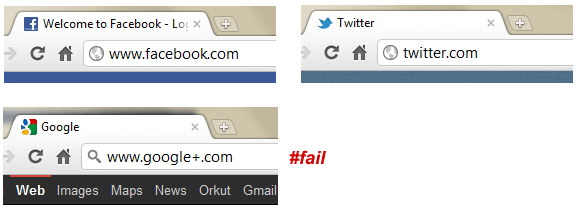
Users access Facebook on www.facebook.com; Twitter on www.twitter.com; and so on – is it www.google+.com?


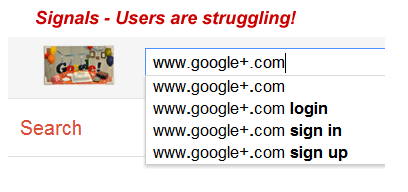
And to prove this point – look at Google+ suggestions on Search –


Accessibility is a big question mark for Google+. The correct way to access Google+ is plus.google.com – which a technology early adopter shall ‘probably’ remember – but even he or she will end up accessing (most of the time) Google+ from within GMail on the notification bar at the top.


This point is also related with next set of arguments – User Psychology & Naming & Identification Psychology. I feel these factors are extremely important to consider while building any consumer product.

3. User Psychology for Consumer Products

For any Internet or mobile product – consumers are quick to label it with its strongest product use-case – which is typically the recall product value of the user. Simply stated for a normal user –
“I visit GMail to check my emails!”
“I visit Google to search the web.”
“I visit Facebook to view what my friends are up to.”


Now it is extremely difficult for any product to have a “and use-case” for a product –
“I visit GMail to check my emails and Social Networking.” – No!
“I visit Google to search the web and Social Networking.” – No!
“I visit Facebook to view what my friends are up to and also searching the world wide web.” – No!

“And use-case” works for features that support any product’s core value. Features that would be to better manage emails (for Gmail), to better display search rankings (for Google Search), to show more types of friend’s activities (for Facebook) and so on.

Google is aiming to take on Facebook with a Social Networking product. But launched it like a feature on Google Homepage (Search) & Gmail (Notification Header). In current avatar, Google+ is a feature – and will gain traction as much as a feature can. It will not gain identity as a social-networking stand-alone product.

Also note the big failures of other “And use-cases” –
“I visit Facebook to view what my friends are up to and also Buy Local Deals.” – Deals was abandoned by Facebook
“I visit Facebook to view what my friends are up to and also to check-in in places” – Places as stand-alone attempt within Facebook failed, but as feature is gaining traction.
“I visit Gmail to check mails and Buzz up articles.” – Google Buzz… remember?

“And use-cases” work for B2B products, but have never worked for any consumer web product.

.

4. Naming & Identification Psychology

Social Graphs & Social Networks are all about giving identity to users. Currently, Google+ itself needs an identity. Users think and will continue to think of Search when they think of Google, and it is virtually impossible for them to perceive Google as a Social Network.

How consumers relate with social activities – “Are you on FB?” “Can you tweet this?” “Let me share it on FB” and so on. The terminology “Google” or “Googled” is built over last 13 years – will be impossible to change from search to a social context.

For sake of Product identity or for its different product use-case, Google+ should have been outside of Google identity with its own identity (probably a www.plus.com if it was available). But the lure of exploring existing user-base is too difficult to give away – and if that logic was to succeed Yahoo! would have still been the largest internet company in this world. They tried to do everything under Yahoo! brand name (Yahoo! Search, Yahoo! Shopping, Yahoo! Finance, Yahoo! Hotjobs, Yahoo! This & Yahoo! That), but for consumers Yahoo! was and always remained a content play.


Even Google’s largely successful consumer products outside Search – Gmail & YouTube were successful because consumers saw it as an independent product identity outside the core of Google’s Search. While Google Video, Google Buzz, Google Answers – all failed. I am strong advocate of one-product = one-identity for consumer web businesses.

5. Social Graphs are occupied; No place for Google+ to fit in

I mentioned in my previous post Building Awesome Social Products – successful social products are reflection of people’s offline behavior in the real world. Similarly – successful social graphs are also reflection of people’s social relationships in real world. Social Products reflect activities, Social Graphs reflect relationships.

A typical user’s social relationships involve –
Close Relationships – Friends, Family, Friendly Colleagues (present and past) – more importantly people you know personally.
Professional Relationships – Colleagues, Business Relationships, Partners
Loose Relationships – People you know, but they probably don’t know you. Celebrities, known professionals, domain experts

Facebook covers Close Relationships, LinkedIn covers Professional Relationships, Twitter covers Loose Relationships. So if Google+ is trying to create a new Social Graph, it will be a struggle (big struggle) – simply cause there is no use-case for a new social graph. Social graphs are distinct; by nature, by user behavior and are established over a period of time.

Features don’t make a product success by itself and expect it to later evolve in to a Social Graph; Instead having a use-case for social graph is essential and the features should evolve.

.

6. It is important to know whom to kill – Facebook, Blogs, Twitter, or what -?

Google+ though it presently looks like a Facebook killer – it is not. None of my friends are using it the way they use Facebook, instead I see more updates from technology adopters in Silicon Valley – and the posts look like extended tweets (beyond the 140 characters). I follow these technology adopters on Twitter, and hence my own assumption that probably it is a Twitter-killer.

Google+ still does not have a clear proposition – and is trying to overlap between all three Social Graphs (Close Relationships, Professional Relationships & Loose Relationships) without taking a clear positioning against one of them.


I am personally not happy with the killer-suffix (no products killers have ever killed anyone – they are still trying to kill iPhone & iPad). But its also important to know who your competition or what your benchmark really is. Or you might just try running behind all, but never able to catch up with any one of them.

.

7. Developer APIs will not enable Social Graphs; Instead Gmail invite contacts are more powerful.

There has been lot of noise about speculated Google+ APIs for developers to build applications and its release dates or so on. Developer APIs will provide access to features – posting an Google+ update, ability to do +1 through applications, and so on – but this sounds (unfortunately once again) like Twitter APIs or FB app APIs that allow you to post status updates and share pictures and so on. Most importantly, Google+ will not be able to build a Facebook Connect equivalent.

Today Social Graphs when referred are mostly Facebook explored through Facebook Connect (unless you write some algorithms on top of them to bring context to your product). F-Connect allows applications & developers to enable Social Graphs (of friends); which clearly explains why 1000s of applications prefer to have Sign-up with Facebook buttons.

Google+ has multiple circles (friends, acquaintances, doctors, techies – and you can delete and rename any other circle); relationships in these circle are mutually not dependent on each other – and hence cannot be explored even if Google+ comes out with a API to access them. Let me explain this below –

a. A user Larry might add another user Zuck in friends circle; Zuck may add Larry in My Gang circle. Hence social relationship between them is not mutual (as friends).
b. Further Larry might name his friends circle as Buddies; Zuck names his friends circles as Pals; Hence the social graph definition itself is flawed.


This is a huge flaw – Through APIs the developer’s applications cannot reach mutually accepted graph of both connections (mutual friends) or an validated status of their relationships (close friends, professional or loose). Hence at this stage it would be more preferred to use the Gmail Invite Contacts module – for simple reason that it is more powerful and treats all contacts at a same level (a social graph of email contacts / connections).

8. Not the best attempt at Social Networking

Google already knows so much about its users – whom do you chat (on GTalk), whom do you mail (on Gmail) or who are my most contacted people in real world (on Android). Google could have actually used a lot of this data, recommended people with circles (I still hate sorting people in circle all the time, but pre-cooked circles by associations would still have been so much better).

With Google holding so much data and wanting to go ahead with a strong social product; it is expecting users to do it again from scratch. Makes one feel that Google+ is a half-baked attempt.

Facebook users usually have about 150 to even 5000 friends. Usually added over years, and all added at a same level – ‘Friends’. However cool the task of adding people to circle is in execution – to add those many people again to circles is a pain. While most people that users see on Google+ are those who are discovered through the people you follow. Every time to add someone to a circle is little more effort than just adding as a friend (on Facebook) or just following the user (on Twitter).

Circle looks like Twitter lists – People get added on them once, later everyone forgets which user is put in what circle. And while the News feed (or stream) stays common for all – the Circles might as well be forgotten just like Twitter Lists.

The next point makes it more clear – why it is not the best attempt at Social Networking.

9. Real Capabilities of Social Graphs (or Networks) are absent -

Get this right – Friends (or Connections!) are the minimum one expects out of a Social Network. What stands out are the capabilities to engage those connections. Remember Orkut? – it had all connections; but Facebook just made the engagement so much better.
Ability to discover Friends or Connections in context -
Google+ has done a simple job or fetching contact list from GMail and enabled it with the painful process (yes!) of adding to circles. But by enabling discovery of friends or connections who are active on Google+ – the suggestion engine for friends could have been so much better.
.
Example -
1. I end of following lot of product enthusiasts & early adopters. There are mutual connections that could be added to my circles – which currently not recommended.
2. My Gmail contacts list have endless email addresses of people I really don’t want to follow in circles or on any social network. So a smart recommendation based on whom I chat with, mutual friends, top contacts on Android and others need to be made discoverable.
.
Stream or Newsfeed -
The most important discovery tool on any Social Platform is Newsfeed. In its current stage – the Stream on Google+ is very Twitterish – a timeline of all people you follow.
.
Facebook raised the standard with algorithms that help you discover feeds that is most relevant to every user, ranking every story contextually around a user. Newsfeed makes or breaks any Social Product and single most important activity & engagement enabler for any Social Product or Social Graph.
.
Communication or Chat -
The most cut-copy-paste feature of Google+ is chat – where user can chat with contacts he otherwise can also on Gmail or Gtalk. Quite honestly, this is the most ridiculous feature, with no context to people any user has put in his circles.
.
In context of chat (or video chat) – expecting users to do Hangouts with webcam is a big No. Hangouts are not conversation starters, but should be featured alongside as planned video conversations.
.
Ability to drive Traffic -

Remember Google Buzz? There was nothing wrong in the idea – attempting a Digg or Facebook Share or Tweet Share. Once a user Buzz’ed an article – it was critical to reach his Social Graph and drive viral traffic to that article. This story failed cause of poor dissemination of activity in user Social Graph. Google should learn lessons from Google Buzz chapter.
.
Social Networks like Facebook & Twitter are popular with publishers or businesses due to their ability to drive traffic to their own websites. While few publishers have added the +1 button to their webpages – still drives only an insignificant proportion of traffic to them; and lot of unclarity on how the dynamics of +1 button works for publishers and its benefits to them eventually.+1, Like, Share, Tweet this – are big distribution mechanisms for a Social Network. Should be given its required TLC.

As mentioned earlier – the product use-case should be driven by features; and not the other way round. Google can always come back and say – we are working on this. But hey, if a product is coming from a product & technology resource-heavy company like Google – even user expectations also very high.

Even these are early days for Google+, web is dynamic and consumer interests change quickly and Google can still do lots of changes quickly and innovate, possibly even work on the above arguments if they agree with it.

This post is written over last several days with some last minute additions on stats before hitting the publish button. Meanwhile Facebook has launched a series of new features, which looks like they are (over)reacting to Google+. Facebook, you are miles ahead, don’t make mistakes, please.